


HANGCHA
Here you can send us an inquiry concerning general questions about Hangcha.
"*" indicates required fields
Every model in our Australian range runs on a lithium-ion battery. Choose by your racking layout, your top beam height and the loads you handle.
The XC Series 1.0–1.2 t reach truck handles lighter pallets up to 7 m in tight aisles. The XC Series 1.4–2.5 t reach truck is built for high-bay racking: it lifts up to 13 m, runs on an 80 V lithium battery, travels at up to 14 km/h, and has preset lift heights and a camera-ready mast so operators can place pallets accurately at the top level.
The A Series 1.2–2.0 t reach truck is a general-purpose model for single-deep racking, with lift heights up to 12.5 m.
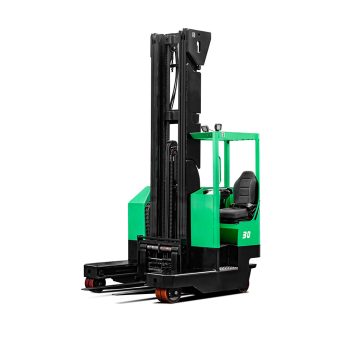
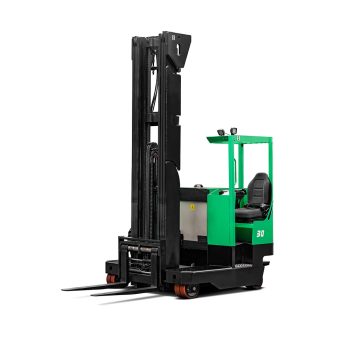
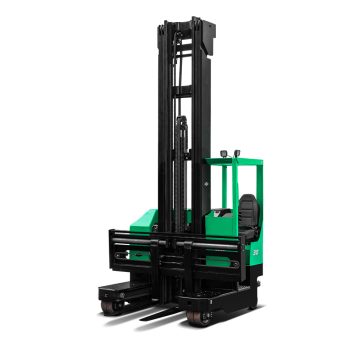
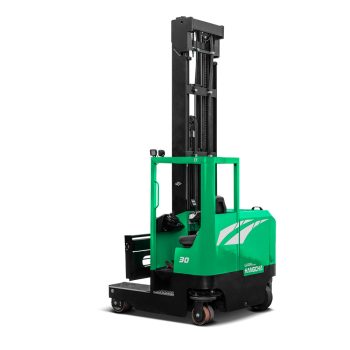
The X Series pantograph reach truck (1.36–2.04 t, up to 7.6 m) extends its forks on a scissor mechanism to reach the rear pallet in double-deep racking. The X Series 4-way reach truck and X Series all-directional reach truck (both 2.0–3.0 t, up to 8.5 m) can travel sideways, so they carry timber, pipe, steel and other long loads lengthways down narrow aisles.
| Model | Capacity | Max lift height | Racking / load | Best for |
|---|---|---|---|---|
| XC Series 1.0–1.2 t | 1.0–1.2 t | 7 m | Single-deep | Lighter pallets in tight aisles |
| XC Series 1.4–2.5 t | 1.4–2.5 t | 13 m | Single-deep, high-bay | Heavier pallets, high racking, multi-shift work |
| A Series 1.2–2.0 t | 1.2–2.0 t | 12.5 m | Single-deep | General high-bay warehousing |
| X Series Pantograph | 1.36–2.04 t | 7.6 m | Double-deep | High-density pallet storage |
| X Series 4-Way | 2.0–3.0 t | 8.5 m | Long loads | Timber, pipe, steel and board |
| X Series All-Directional | 2.0–3.0 t | 8.5 m | Long loads | Long loads in the tightest layouts |
Start with the aisle the truck has to work in. Every model's specification sheet lists a working aisle width (Ast) for a given pallet size. Compare that figure, plus a safety clearance of about 200 mm, with your narrowest aisle. Most single-deep warehouses run reach truck aisles of 2.7 to 3.0 m. For the figures on each model, see our reach truck selection guide.
Capacity drops as the mast extends, so the rated capacity is not what it can lift at your top beam. Check the residual capacity at your highest storage level on the capacity chart, and choose a model that still carries your heaviest pallet with about 15% to spare.
Single-deep racking suits a standard model. Double-deep racking needs a pantograph model to reach the rear pallet without repositioning. Long loads need a 4-way or all-directional model.
Reach trucks are designed for flat, level indoor floors, and the higher you lift, the flatter the floor needs to be for accurate placement. Keep ramps to a minimum and well within the truck's rated gradeability.
For long shifts and high racking, a sit-down model such as the XC Series keeps operators comfortable and makes top-level placement easier with preset heights. Match the truck to your shift pattern and pick rate, not only your pallet weight.
| Your warehouse | Recommended reach truck |
|---|---|
| Single-deep racking up to 7 m, lighter pallets | XC Series 1.0–1.2 t |
| High-bay racking to 13 m, pallets up to 2.5 t, multi-shift operation | XC Series 1.4–2.5 t |
| General single-deep racking up to 12.5 m | A Series 1.2–2.0 t |
| Double-deep racking for higher storage density | X Series Pantograph |
| Timber, pipe or steel lengths in narrow aisles | X Series 4-Way |
| Long loads in the tightest layouts, with travel in any direction | X Series All-Directional |
Lithium-ion means no battery watering, no acid fumes and no dedicated battery room. Operators can top up the charge during breaks instead of swapping batteries between shifts. On the XC Series 1.4–2.5 t, the 80 V CATL lithium battery is rated for around 10 hours of work with about 2 hours of fast charging, depending on the duty cycle.
We hold stock and parts in Dandenong (VIC), Smeaton Grange (NSW) and Meadowbrook (QLD). Our service teams handle scheduled servicing from the same three sites, and we offer operator training for your team. Explore our full range of narrow aisle forklifts for other warehouse applications.