


What Is an Electric Pallet Jack?
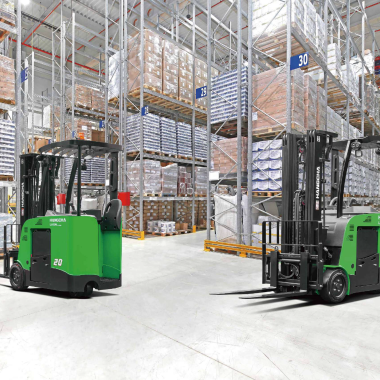
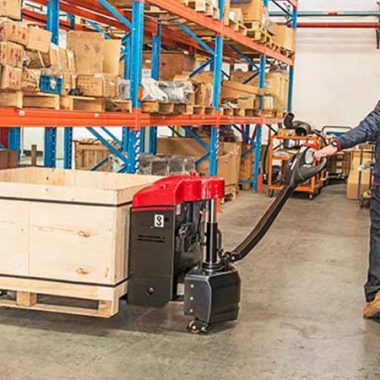
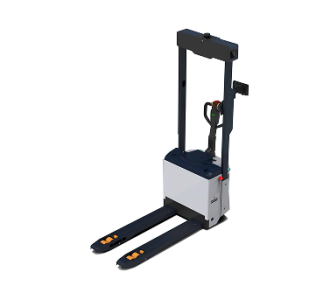
Electric Pallet Jack (Electric Forklift / Electric Pallet Truck) is an electric equipment used for short-distance handling of palletised goods within warehouses. It is mainly used for low-lift horizontal movement operations. Compared to manual pallet trucks, the electric model is driven by an electric motor, significantly reducing the manual operation intensity and improving operational efficiency. It is particularly suitable for environments requiring frequent handling. Therefore, it is widely used in logistics storage centre, retail backroom, cold chain warehouse and so on.
Core features of the electric pallet Jack include:
- Load capacity range: 1,500 kg – 3,000 kg
- Lifting height: 80 mm or 125 mm
- Compact structure, suitable for operation in narrow passages
- Offer two types: Walkie (walking mode) and Rider (stationary mode)
- Optional lithium battery system, with fast charging and low maintenance costs
Since electric pallet jack is a low lift horizontal transport equipment, the main workplaces include flat storage floor and shelf aisle. Therefore, what truly determines the practicability of equipment is not the load capacity, but minimum channel width and turning radius.
Understanding Aisle Width (Ast) Requirements
Aisle Width refers to the minimum width of the passage required for the equipment to operate normally and make turns.
If the passage is too narrow, it may lead to:
- The equipment is unable to make a smooth turn.
- It requires multiple adjustments of direction, which reduces efficiency.
- Increase the risk of shelf damage or goods collision
- There are safety hazards.
The factors influencing the requirements for channel width
When choosing an electric pallet jack, the aisle width is not a simple “reference value” but is determined jointly by the structural dimensions of the equipment and the size of the pallet. Each structural parameter will directly affect the running path of the equipment when turning and entering the shelves.
First, there is the overall length of the vehicle body (Overall Length). The longer the vehicle body, the larger the axle distance usually is, and the larger the sweeping trajectory formed by the equipment when turning on the outside. This means that the turning radius will increase, thereby directly raising the minimum channel width requirements. Especially for Rider-type equipment with a station platform, due to the longer rear extension structure of the vehicle, the tail swing space during turning is larger. Therefore, it usually requires a wider channel than compact Walkie equipment.
The next factor is the length of the forks (Fork Length). The length of the forks determines the extension distance of the tray’s front end while turning around. The longer the forks, the larger the sweeping radius formed by the tray’s front end during the turn, and the more space is required when entering the storage aisle. For high-density storage environments, this difference will directly affect the design of the shelf layout.
The third key factor is tray/pallet size. In the Australian market, the common tray lengths are 1165mm or 1200mm. The longer the tray, the greater the extension distance at the front end during turning, which means a wider aisle is needed. In high-density warehouses, even a 30–40mm size difference can have an impact on the overall channel planning.
Finally, there is the turning radius (Turning Radius). This is a core parameter that affects the width of the passage. The smaller the turning radius, the less space the equipment requires to complete a 180° turn. Compact Walkie electric pallet jacks usually have a smaller turning radius, so they are suitable for narrow environments; while Rider-type equipment has longer body and larger wheelbase, which requires a passage width at least of 3.1m to operate smoothly. If the turning radius does not match the width of the passage, operational stalling may occur.
The specific measurements before purchasing
Before purchasing an electric pallet jack, merely “checking the parameter table” is not sufficient. A site survey of the actual warehouse environment is necessary.
First, the effective width (Ast) of the narrowest aisle in the warehouse should be measured. The key here is “effective width”, not the nominal width. When measuring, use inner side of the shelf as the standard, and deduct the occupied space by the anti-collision barriers, post protection devices, or any fixed obstacles. Many warehouses demonstrates that the aisle width is normally more than 3000mm, but after deducting the barriers’ length, the actual usable space may be less than 3000mm.
Secondly, the floor flatness needs to be checked. Electric pallet jacks are low body equipment. If the ground is uneven, the actual turning trajectory may expand due to unstable pressure on its tire. To prevent that happen, it is better to use a laser equipment to measure the ground and ensure the difference among ground height does not exceed 5-10mm within 4 square meters. In summary, the smoother the ground, the more precise the equipment’s turning control will be.
Thirdly, gradients or slopes should be measured (Gradients). The slope not only affects the driving performance but also influences the stability during turns. The slope can be calculated as a percentage by measuring the height difference and the horizontal distance. Generally, when the slope exceeds 5%, it is necessary to confirm whether the motor power and braking capacity of the equipment are sufficient; if it exceeds 8%, special consideration should be given to the equipment’s load capacity and anti-slip performance. In a slope environment, the turning radius usually increases slightly, so additional space should be reserved in the channel design.
Finally, the maximum actual load requirement needs to be determined. It should be based on the peak load rather than the average weight. For example, if the cargo weight occasionally reaches 1800kg, the maximum load of the equipment should not exactly be 1800kg. Instead, a safety margin should be left. Operating electric pallet jack to the maximum load for a long time will increase the burden on the motor and extend the braking distance, thereby leading to safety hazards.
Properly matching the equipment with the channel width can:
- Improve the utilization rate of space
- Reduce congestion in the channels
- Improve the overall efficiency of the work process
Understanding Turning Radius Requirements
Turning Radius is the minimum circular space required for a device to achieve a 180° rotation.
The turning radius is particularly important in narrow working places.
A smaller turning radius means:
- Easier to operate in narrow passages
- Reduce the need for multiple reversing adjustments
- Improve the efficiency of goods placement
- Reduce the risk of collision
The size of the turning radius is mainly determined by the structural design of the equipment. Firstly, the layout of the vehicle body structure will affect the overall length and centre of gravity of the vehicle, which in turn changes the radius of the turning path. Secondly, the arrangement of the driving wheels will also have an impact. For example, front-wheel drive or mid-mounted drive systems will affect the position of the steering pivot. The closer the driving wheels are to the centre of the vehicle, the more likely it is to reduce the turning radius. Axle spacing design is also crucial. The longer the axle spacing, the larger the arc radius formed by the vehicle during turning. Therefore, compact equipment often achieves a smaller turning space requirement by shortening the axle spacing. The walkie-style electric pallet packs have a compact structure with smaller turning radius, which makes them fit for narrow warehouse environments. In the other hand, rider-style models are good at large-scale storage and long-distance transportation.
How to Choose the Right Electric Pallet Jack for Your Warehouse
Step 1: Measure the channel width (Ast)
Confirm the dimensions of the narrowest passage to ensure that the equipment can safely complete the turning and handling operations. During the measurement, the space occupied by the anti-collision barriers and column protection pieces should be deducted. After obtaining the effective channel width, the maximum turning radius that the equipment is allowed to have can be calculated in reverse:
Maximum allowable turning space = Effective aisle width- Pallet Length – Safety Margin
It is recommended to reserve a safety margin of 150–200mm.
Step 2: Assess the turning space
If the warehouse layout is compact, it is advisable to choose the Walkie model with a smaller turning radius.
Remaining maneuvering space ratio = (Effective aisle width − Required turning space)
÷ Effective aisle width
When this ratio is less than 0.05 (that is, 5 percent), it indicates that the equipment almost occupies the entire channel space, with extremely low operational errors. In this case, the Walkie type equipment with a smaller turning radius should be given priority.
Step 3: Confirm the maximum loading ability
Select the model whose maximum carry weight meets the actual loading weight.
Recommended rated load capacity
≥ Maximum actual load weight
÷ Load safety factor
Step 4: Consider the ground conditions
If there are ramps in the warehouse, the slope should be measured precisely:
Slope percentage = (Vertical height difference ÷ Horizontal distance) × 100
Step 5: Match the workload intensity
- Small warehouse + Narrow passage → Mini Walkie
- Medium-sized and large warehouses + Long-distance handling → Rider
- Heavy industrial environment → Hi Range
Considering both the channel width and the turning radius, it is possible to avoid efficiency degradation or safety risks caused by incompatible equipment sizes.