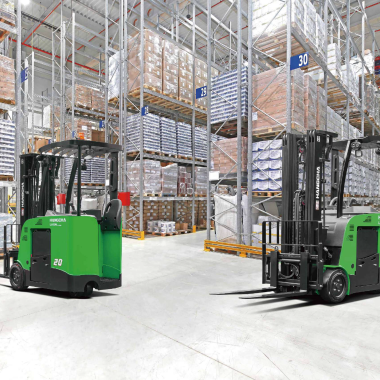


A narrow aisle warehouse sounds simple on paper. Reduce the aisle width, add more racking, store more pallets, and make better use of the same floor space. In real operations, it is not quite that simple.
The right aisle width depends on the forklift, pallet size, load shape, rack layout, lift height, floor condition and how your operators move through the warehouse every day. Before choosing a Narrow aisle forklift, the better question is not how narrow can we go? It is what aisle width allows us to work safely, efficiently and consistently?
Why Aisle Width Matters More Than Most Buyers Think
Aisle width affects more than storage density. It changes how quickly operators can place pallets, how often they need to correct their position, how much space they have at aisle ends, and how likely the forklift is to contact racking, stock or pedestrians.
A very tight layout may look good in a drawing, but if every pallet movement becomes slow and stressful, the warehouse may lose time instead of saving space. In many warehouses, a slightly wider aisle can be more productive than a layout that pushes equipment to its limit.
Safe Work Australia’s warehouse traffic management guidance also makes a key safety point: where forklifts are used, the best way to reduce forklift-related injury risk is to separate pedestrians and forklifts. If that is not possible, businesses should consider layout changes, barriers and traffic controls. You can read the guidance from Safe Work Australia here.
That matters because aisle width is not only a storage decision. It is also a traffic management decision.
Typical Aisle Widths for Different Forklift Types
Every site should be assessed properly, but these ranges are useful when planning a warehouse layout.
| Equipment type | Typical aisle width guide | Common use case |
| Counterbalance forklift | Around 3.5m to 4.0m or more | Loading, unloading, general pallet movement and wider warehouse aisles |
| Reach truck | Around 2.7m to 3.2m | High racking, pallet storage and narrow aisle operations |
| Very narrow aisle equipment | Around 1.6m to 2.0m | High density storage, guided systems and dedicated VNA zones |
| Order picker | Varies by model and task | Case picking, small item picking and operator-up applications |
These figures are not a substitute for the forklift specification sheet or a site check. They are a practical starting point. If your aisles are around 2.7 metres or wider, a reach truck or narrow aisle solution may be suitable. If your aisles are much tighter, you may need a more specialised very narrow aisle system, wire guidance, rail guidance or a different picking strategy.
The Real Factors That Decide Your Aisle Width
Pallet size and load overhang
A forklift does not only move the pallet. It moves the pallet plus the actual load sitting on it. If cartons, timber, wrapped goods or machinery parts overhang the pallet, your forklift needs more usable clearance than the pallet size alone suggests.
This is one reason two warehouses with the same aisle width can have very different results. A clean, consistent pallet operation may work well in a tighter aisle. Mixed loads, damaged pallets or irregular stock usually need more margin.
Right angle stacking aisle
Forklift specifications often refer to right angle stacking aisle width, sometimes shown as Ast. This is the space needed for the forklift to turn and place a load into racking at 90 degrees. It is one of the most important numbers to check when comparing equipment.
However, the real warehouse still needs practical clearance. Rack protectors, column guards, floor markings, stock stored near aisle ends and pedestrian zones can all reduce usable space.
Lift height and load capacity
A forklift may be rated for a certain capacity, but load capacity can change at higher lift heights. If your warehouse has tall racking, do not only check whether the forklift can reach the top beam. Check whether it can safely lift your typical pallet weight to that height.
This is especially important in narrow aisles, where stability, visibility and control matter more.
Floor condition
Narrow aisle equipment works best on a floor that supports smooth, predictable movement. Uneven floors, slopes, expansion joints or damaged concrete can make tight aisle operation harder, especially at height.
For very narrow aisle systems, floor flatness and guidance systems may become part of the decision. That means the warehouse may need more than a forklift purchase. It may need a layout and infrastructure review.
Is 2.7 Metres Enough?
For many warehouses, 2.7 metres is a common decision point. If your aisles are around this width, a reach truck or Narrow aisle forklift may be a practical option, especially for standard pallet storage and high racking.
But 2.7 metres is not automatically enough for every site. It depends on:
- The exact forklift model
- Pallet size and load depth
- Whether loads overhang
- Rack depth and beam layout
- Turning space at aisle ends
- Operator skill and daily traffic flow
- Whether pedestrians share nearby areas
If the operation involves oversized pallets, frequent turning, tight end-of-aisle movements or mixed traffic, you may need more than the minimum figure shown on a spec sheet.
Common Mistakes When Planning Narrow Aisles
One common mistake is designing racking first and choosing the forklift later. This can leave the business with aisles that look efficient but do not suit the equipment.
Another mistake is measuring from drawing to drawing rather than rack face to rack face. The usable aisle may be narrower once rack protection, floor markings and stock placement are considered.
A third mistake is focusing only on storage capacity. More pallet positions are helpful, but not if picking becomes slower, forklift damage increases or operators need extra time for every movement.
A better approach is to match the forklift, racking and workflow together.
How to Measure Before You Choose
Before you decide on equipment, collect the following information:
- Clear aisle width between rack faces
- Pallet size and actual load size
- Maximum pallet weight
- Highest lift point required
- Rack depth and beam levels
- Floor condition and slope
- Aisle end clearance
- Pedestrian routes and traffic crossings
- Indoor or mixed indoor outdoor use
- Daily pallet movements and peak periods
With this information, a forklift specialist can give much more accurate advice than a general model comparison.
Final Thoughts
The right aisle width is not always the narrowest aisle you can physically fit into. It is the aisle that allows your team to move pallets safely, protect racking, maintain speed and make full use of your warehouse space.
If you are planning new racking, upgrading from a counterbalance forklift, or trying to improve storage density, speak with Hangcha Australia before locking in your aisle dimensions. Our team can help you assess your layout, compare forklift options and choose a solution that suits the way your warehouse actually works.